The Millisecond Tax: How Messaging Lag in Data Center Operations Drains Energy and Erodes the Bottom Line
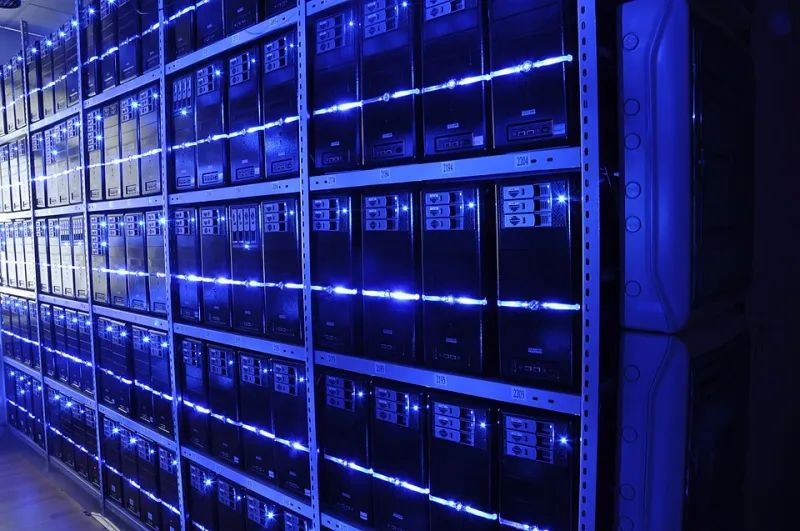
Photo: BalticServers.com, CC BY-SA 3.0, via Wikimedia Commons
A Problem Hiding Inside the Infrastructure
Data center operators spend considerable effort optimizing for the obvious variables: hardware efficiency ratings, cooling system design, renewable energy procurement, and power usage effectiveness benchmarks. These are the metrics that appear in sustainability reports and earn recognition from industry bodies. What rarely gets the same level of scrutiny is the communication architecture that ties all of those systems together — specifically, the latency introduced when monitoring platforms, energy management controllers, and operational dashboards exchange information through outdated or poorly integrated messaging layers.
The argument here is straightforward but frequently overlooked: when the systems responsible for managing energy consumption cannot communicate with each other in real time, they operate on stale data. And systems operating on stale data make suboptimal decisions. In a data center environment, suboptimal decisions about cooling, load distribution, and power routing translate directly into wasted kilowatts — at a scale that, across a full year, represents a significant and recoverable cost.
How Latency Enters the Energy Loop
To understand the mechanism, it helps to trace the path that a typical energy signal takes through a modern data center's operational stack.
A temperature sensor in a server rack detects an anomalous reading. That reading is transmitted to a building management system. The building management system evaluates the reading against threshold parameters and, if warranted, sends a command to the cooling infrastructure to increase airflow to that zone. The cooling system responds, draws additional power, and the rack temperature normalizes.
In an ideal scenario, this entire cycle completes in seconds. In practice, many enterprise data centers are running this loop through messaging architectures that introduce delays of 30 seconds to several minutes at each handoff point. Legacy SCADA systems, polling-based sensor networks, and middleware layers that were designed for a previous generation of infrastructure are common culprits. When the cooling system finally receives the command to respond, the thermal event may have already self-resolved — or, more commonly, may have escalated to the point where a more aggressive and energy-intensive response is required.
This is the millisecond tax. It is not paid in a single dramatic incident. It is paid continuously, in small increments, across every automated decision the facility makes.
Quantifying the Inefficiency
Industry analysis and operational data from large-scale data center operators suggest that facilities running synchronous, low-latency communications between monitoring and energy systems consistently demonstrate power usage effectiveness figures 8 to 18 percent better than comparable facilities operating with fragmented or high-latency messaging architectures. For hyperscale environments, even a one-point improvement in PUE can represent millions of dollars in annual energy cost reduction.
For mid-tier enterprise data centers — the 5,000 to 50,000 square foot facilities that house the infrastructure for regional banks, healthcare systems, and manufacturing operations across the American Midwest and South — the dynamics are similar but the proportions are different. A facility consuming 2 megawatts of power at an average commercial electricity rate of $0.08 per kilowatt-hour spends roughly $1.4 million annually on electricity. A conservative 15 percent efficiency improvement attributable to better communications architecture represents $210,000 in annual savings. Against the cost of a modern, well-integrated messaging platform upgrade, the payback period in most documented cases falls between 14 and 22 months.
The Specific Failure Modes
Not all latency problems look the same. Three distinct failure modes appear consistently across data center environments that have not modernized their communications infrastructure.
Polling versus event-driven architectures. Many older building management systems use polling — periodically querying sensors for their current state rather than receiving real-time event notifications when conditions change. A system polling every 60 seconds is, by definition, always operating on data that is up to a minute old. In environments where thermal conditions can shift meaningfully in under 30 seconds during peak compute loads, this gap is operationally significant.
Protocol fragmentation. Data centers frequently run multiple generations of infrastructure, each communicating through different protocols — BACnet, Modbus, MQTT, proprietary vendor APIs. Without a unified messaging layer that normalizes and routes these signals efficiently, data must be translated and re-transmitted at each boundary, introducing both latency and the possibility of data loss or corruption. Energy management decisions made downstream of these translation layers are only as good as the data that survived the journey.
Dashboard-driven rather than automated response. In facilities where human operators are expected to review monitoring dashboards and manually initiate energy responses, the latency is not measured in milliseconds but in minutes or hours. This model was appropriate when infrastructure was simpler and less dynamic. In a modern virtualized environment where workloads shift continuously across physical hardware, human-in-the-loop energy management simply cannot keep pace.
The Architecture That Solves It
The communications infrastructure required to eliminate these inefficiencies is not exotic. The core requirement is an event-driven messaging backbone — a platform capable of ingesting sensor data in real time, routing it to the appropriate control systems without polling delays, and triggering automated energy responses based on predefined logic and machine learning models.
Several enterprise platforms now offer purpose-built solutions for this use case, integrating time-series data from IoT sensors with energy management controls through low-latency message queues. The key design principles are consistent across implementations: minimize the number of protocol translation boundaries, replace polling with push-based event notification wherever possible, and ensure that automated response logic sits as close to the data source as the architecture allows.
For organizations evaluating an upgrade, the ROI calculation should account not only for direct energy savings but also for the reduction in reactive maintenance costs that accompanies better thermal management, the extension of hardware lifespan that results from more stable operating conditions, and the improved ability to participate in utility demand-response programs — which increasingly require near-real-time telemetry from participating facilities.
Rethinking the Data Center as a Communications Problem
The framing that tends to unlock investment in this area is a simple one: a data center is not just an energy system with computers in it. It is a communications system that happens to consume enormous amounts of power. The efficiency of the energy system is directly constrained by the quality of the communications architecture that governs it.
Organizations that have internalized this framing — that treat the latency of their monitoring and control messaging with the same seriousness they apply to network performance in their production environments — are consistently outperforming peers on both efficiency metrics and operational resilience. The millisecond tax is real, it is measurable, and for most enterprises, it is entirely recoverable.