Five Platforms, Zero Coherence: The Real Price Your Business Pays for Communication Fragmentation
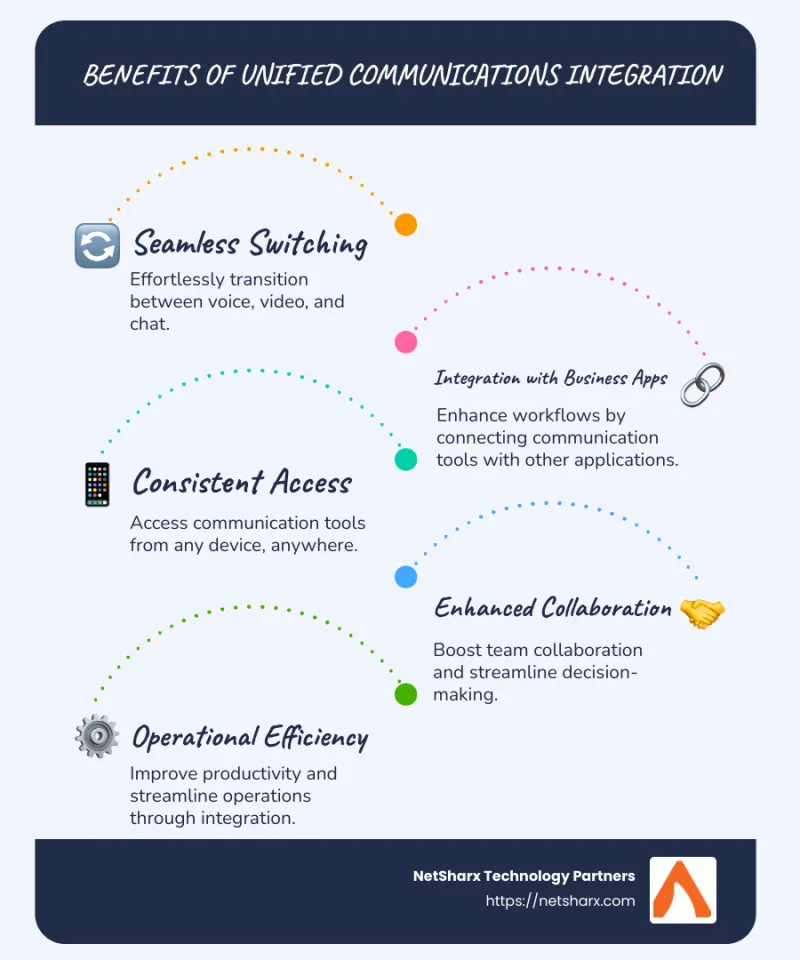
Photo: business communication platform integration unified office technology, via images.bannerbear.com
The Accumulation Problem Nobody Planned For
No organization set out to run six communication platforms simultaneously. It happened gradually — a Slack workspace adopted by one team for speed, a Microsoft Teams rollout mandated from IT, a legacy email infrastructure that predates anyone's tenure, a project management tool with its own built-in messaging layer, a customer-facing chat system that the sales team insists on, and a video conferencing license that someone renewed before the bundled option became available. Each addition made sense in isolation. Together, they form a fragmented architecture that costs far more than the sum of its subscription fees.
For mid-market companies — broadly defined as US businesses with annual revenues between $10 million and $1 billion — this pattern is not an edge case. It is the norm. And the consequences extend well beyond the minor inconvenience of switching between tabs.
Quantifying What Fragmentation Actually Costs
The financial impact of communication silos manifests across three distinct categories, each of which deserves examination on its own terms.
Productivity erosion through context switching. Research on knowledge worker efficiency consistently identifies task-switching as one of the most significant drains on cognitive output. When employees must monitor multiple platforms, reconcile notifications from overlapping systems, and make judgment calls about which channel is appropriate for which type of message, they are expending mental bandwidth that would otherwise go toward substantive work. Industry estimates suggest that professionals in fragmented communication environments lose between 60 and 90 minutes per day to this kind of overhead. At an average fully-loaded labor cost of $45 to $75 per hour for US knowledge workers, that figure translates to thousands of dollars per employee annually — before any other cost category is considered.
Security vulnerabilities that multiply with every disconnected system. Each platform in your communication stack represents an attack surface. Authentication credentials, data access permissions, and integration points must be managed independently across every tool. The more systems an organization operates, the greater the probability that one of them will have a misconfigured permission, an outdated security patch, or an orphaned account belonging to a former employee. The 2023 Verizon Data Breach Investigations Report identified credential compromise and human error as the leading factors in data breaches — both of which become statistically more likely as the number of managed platforms increases. For mid-market companies without enterprise-grade security teams, this is not a theoretical risk.
Redundant infrastructure driving up cloud and energy expenditure. Every communication platform your organization subscribes to is backed by data center infrastructure — servers, storage, networking equipment — that consumes electricity around the clock. When you operate five platforms instead of one unified system, you are not consuming five times the energy of a single platform. But you are consuming meaningfully more than necessary, and you are paying for redundant data storage, duplicated processing, and overlapping bandwidth consumption. For organizations with 200 or more users, the difference in cloud spend between a fragmented stack and a consolidated one can reach five figures annually.
Why Mid-Market Companies Are Particularly Vulnerable
Large enterprises have the resources to build governance structures around their technology stacks — dedicated IT architects, vendor management teams, and enterprise agreements that create pressure to standardize. Small businesses, by contrast, often operate a single platform by default. The mid-market occupies an uncomfortable middle ground: large enough to accumulate complexity, but frequently without the internal infrastructure to govern it.
Decision-making authority over communication tools is also typically distributed in mid-market organizations. The marketing team adopts a tool, the engineering team adopts another, and the executive suite defaults to whatever their executive assistant configures. Without a centralized technology strategy — or a senior leader with explicit ownership of the communication stack — fragmentation compounds organically and continuously.
A Framework for Auditing Your Current Communication Stack
Before any consolidation strategy can be designed, organizations need an honest inventory of what they are running and what it is costing them. The following framework provides a structured starting point.
Inventory every active platform. Compile a complete list of communication and collaboration tools currently in use across the organization. Include tools that individual teams have adopted independently, not just those that appear in the IT budget. Shadow IT — tools employees use without formal organizational approval — is frequently responsible for 20 to 30 percent of the total platform count in mid-market environments.
Map functional overlap. For each platform, document its primary function. Then identify where two or more platforms serve functionally equivalent purposes. Persistent messaging, for example, is available in Slack, Microsoft Teams, Google Chat, and the messaging layers embedded in tools like Asana or Monday.com. Organizations that run multiple tools with overlapping messaging functions are paying for the same capability repeatedly.
Calculate the fully-loaded cost per platform. Subscription fees are only one component of the total cost. Add the administrative time required to manage each platform, the security overhead associated with maintaining access controls and monitoring, the onboarding cost for new employees who must be trained on each tool, and an estimated productivity cost based on the number of users and the switching overhead they incur.
Assess integration quality. For platforms that serve genuinely distinct functions, evaluate whether they integrate meaningfully with the rest of your stack. A project management tool that does not connect to your primary messaging platform forces employees to manually replicate information across systems — a direct driver of both productivity loss and data inconsistency.
Score each platform against a retention criterion. Using the data collected above, evaluate each platform against three questions: Does it serve a function not covered by any other tool in the stack? Is its fully-loaded cost justified by the value it delivers? Does it integrate sufficiently with the platforms you intend to retain? Any platform that fails two or more of these criteria is a consolidation candidate.
The Case for Unified Communications as a Strategic Investment
Consolidating a fragmented communication stack is not simply a cost-cutting exercise. It is a structural investment in organizational coherence — the kind that pays dividends in faster decision-making, reduced security exposure, and a more consistent employee experience.
Unified communications platforms — those that combine messaging, voice, video, and file collaboration within a single integrated environment — have matured substantially over the past five years. The leading offerings in the US market now support the full range of communication workflows that mid-market companies require, with enterprise-grade security controls and sufficient customization to accommodate diverse team needs.
The transition does require deliberate change management. Employees who have built workflows around specific tools will resist displacement, and that resistance is legitimate. A phased migration plan that accounts for team-level adoption patterns, provides adequate training, and communicates the rationale clearly will outperform a hard cutover in both adoption rate and long-term retention.
The organizations that have navigated this transition successfully share a common characteristic: they treated communication consolidation as a strategic initiative, not an IT project. When senior leadership owns the outcome and ties it to measurable business objectives — reduced operational cost, improved security posture, faster cross-functional collaboration — the case for change becomes compelling at every level of the organization.
The fragmentation that currently defines your communication stack did not happen by design. Resolving it, however, requires exactly that.