What Your Vendors Cannot See Is Costing You Megawatts: The Case for Transparent Supply Chain Communications

Photo: Omoeko Media, CC BY-SA 4.0, via Wikimedia Commons
For most enterprises operating across distributed supply chains, the energy conversation tends to center on the obvious suspects: warehouse lighting, fleet fuel consumption, and data center draw. What rarely enters the boardroom discussion is the compounding waste that originates not from physical infrastructure, but from the communications architecture — or lack thereof — that connects vendors, logistics partners, and internal operations teams.
Fragmented messaging is not merely an inconvenience. It is an energy liability.
The Visibility Problem Nobody Is Quantifying
Consider a mid-sized manufacturer coordinating across a network of ten suppliers, three third-party logistics providers, and two distribution centers. Each stakeholder likely relies on a different combination of email threads, proprietary portals, EDI systems, and ad hoc phone calls to exchange operational data. Shipment status, inventory levels, equipment utilization, and routing decisions all flow through disconnected channels that no single party can observe in full.
The consequence is predictable: decisions get made on stale information. A distribution center keeps its loading bay equipment running in standby mode for an inbound shipment that was rerouted six hours earlier — because no one pushed a real-time notification through a shared channel. A logistics partner dispatches a partially loaded truck on an inefficient route because the inventory system update did not reach the dispatch coordinator in time. A vendor runs its production line at full capacity for an order that was already partially fulfilled by a secondary supplier.
Each of these scenarios represents a discrete energy expenditure that serves no productive purpose. Across a supply chain with dozens of such handoff points, the aggregate waste is not trivial.
Fragmentation as an Amplifier of Inefficiency
The core problem is not that individual systems are poorly designed — it is that they were never designed to speak to one another. When communications are siloed, energy-relevant data points become invisible to the stakeholders who could act on them. An idle server at a fulfillment partner's facility is invisible to the enterprise's sustainability team. A redundant cross-country shipment generated by a miscommunication between procurement and logistics does not appear on any single energy audit because it spans multiple organizations.
This is the structural challenge that unified, real-time communications platforms are positioned to address. When all supply chain stakeholders operate within a shared visibility layer — one that surfaces operational data alongside messaging in a single interface — the energy implications of decisions become legible to everyone involved.
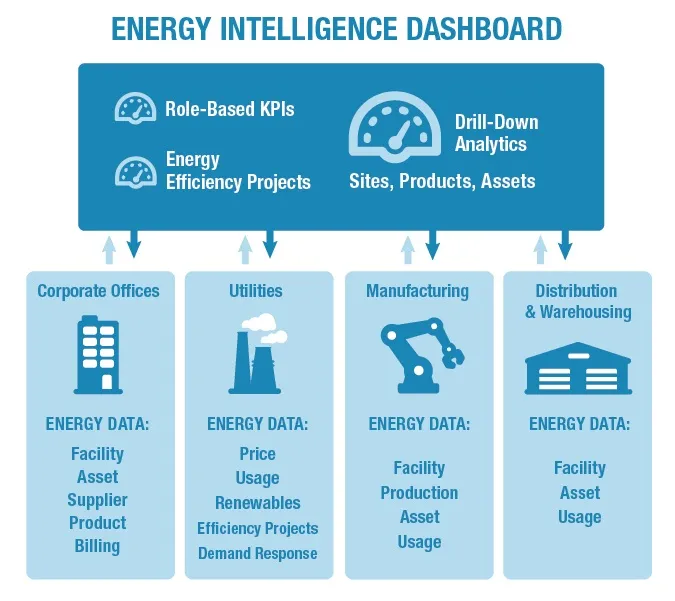
Modern supply chain communication platforms now offer capabilities that extend well beyond simple message routing. Integration with ERP systems, IoT sensor feeds, and logistics management software allows these platforms to surface contextual alerts: a warehouse's HVAC system running at full capacity during a low-occupancy period, a carrier's vehicle idling beyond a predefined threshold, a cold storage unit maintaining temperature for inventory that has already shipped. These are actionable energy insights, and they are only surfaced when communications infrastructure is unified enough to connect the data sources.
Real-Time Messaging as an Operational Control Mechanism
The distinction between reactive and proactive energy management in supply chains often comes down to timing. A logistics coordinator who receives a route change notification thirty minutes before dispatch can redirect resources efficiently. The same notification arriving three hours later — after a truck has already departed on an energy-intensive detour — generates waste that cannot be recovered.
Real-time communications architecture changes the economics of that timing equation. When stakeholders share a common messaging layer that integrates with operational systems, exception alerts travel at the speed of the underlying data rather than the speed of human follow-up. Redundant shipments can be flagged before they leave the dock. Idle infrastructure can be powered down before the next billing cycle absorbs the cost.
Several US-based logistics operators have begun piloting unified communications platforms specifically to reduce what internal analysts describe as "coordination overhead" — the energy and labor cost of managing the gaps between systems. Early findings suggest that eliminating even a fraction of redundant shipments through better real-time coordination can produce measurable reductions in both fuel expenditure and associated emissions.
The Stakeholder Alignment Dimension
There is a second-order benefit to communications transparency that deserves attention: it creates shared accountability for energy outcomes across organizational boundaries. When a vendor can see, in real time, that their delayed shipment confirmation has triggered a redundant logistics run, the energy cost of that delay becomes concrete rather than abstract. When a logistics partner's routing decisions are visible to the enterprise's sustainability team, energy efficiency becomes a shared metric rather than a siloed internal goal.
This alignment dynamic is particularly relevant for enterprises with formal sustainability commitments — a growing segment of the US corporate landscape as ESG reporting requirements continue to evolve. Scope 3 emissions, which encompass supply chain and logistics activities, represent the largest and most difficult-to-measure portion of most companies' carbon footprints. Transparent communications infrastructure does not solve the Scope 3 measurement problem entirely, but it substantially improves the data granularity available to sustainability teams attempting to model and reduce that footprint.
Building the Business Case
For operations and technology leaders evaluating communications platform investments, the energy efficiency angle offers a compelling supplementary justification that goes beyond productivity gains. The calculation is straightforward in principle: identify the categories of waste that stem from communication latency or fragmentation — redundant shipments, idle equipment, inefficient routing — estimate their energy cost, and model the reduction achievable through real-time visibility.
In practice, that modeling requires collaboration between operations, IT, and sustainability functions that does not always occur naturally. The organizations making the most progress are those that have designated a cross-functional owner for supply chain communications architecture — someone whose mandate explicitly includes energy efficiency outcomes alongside operational performance metrics.
The technology is available. The integration pathways exist. What most enterprises are still working to develop is the organizational clarity to treat communications infrastructure as an energy management tool, not merely an operational convenience.
In a supply chain context, those two functions are inseparable. The sooner enterprises recognize that distinction, the sooner the megawatts hiding in their vendor relationships become recoverable.