The Carbon Cost of Connectivity: How Your API Strategy Is Quietly Running Up the Energy Bill
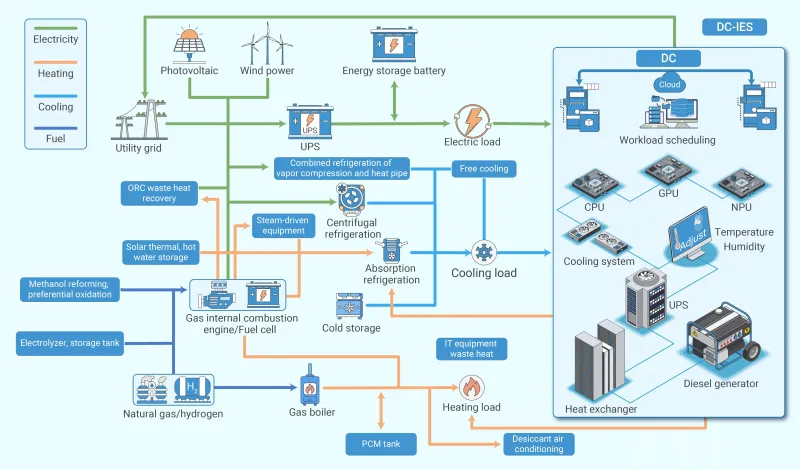
Photo: API integration architecture diagram data center server energy consumption technology, via data.the-innovation.org
There is a version of technical debt that does not show up on a developer's backlog. It does not generate a ticket, trigger an alert, or appear in a sprint retrospective. It lives in the space between systems — in the integration layer where applications communicate with one another — and it expresses itself not as a software failure but as an electricity bill.
API sprawl is the integration equivalent of leaving every light in the building on indefinitely. And in organizations that have grown their digital infrastructure through years of acquisitions, platform migrations, and point-to-point integrations, the energy consequences of poor API architecture are both substantial and almost entirely unexamined.
How Integration Decisions Become Energy Decisions
Every API call consumes compute resources. Every data transfer traverses network infrastructure. Every middleware process that sits between two systems requires memory, processing cycles, and — ultimately — electricity. In isolation, these costs are negligible. At enterprise scale, across hundreds of integrations running continuously, they are not.
The problem is compounded by the way most organizations have built their integration strategies. Rather than designing a coherent, event-driven architecture from the outset, the typical enterprise has layered integration solutions on top of one another over many years. A legacy SOAP service connects to a middleware platform that was modern in 2014. That platform feeds a REST API that was bolted on during a cloud migration. The REST API is polled by three separate downstream applications, each of which checks for updates on its own schedule, regardless of whether any new data actually exists.
This is polling-driven integration, and it is one of the most energy-inefficient patterns in common enterprise use. A system that polls an API every 60 seconds is making 1,440 requests per day. If 90 percent of those requests return unchanged data — which is typical in many business contexts — the system is performing 1,296 unnecessary round trips daily, each consuming compute and network resources at both ends of the connection. Multiply that pattern across dozens of integrations and the waste becomes structurally significant.
The Redundancy Problem Nobody Audits
Beyond polling inefficiency, API sprawl introduces another form of energy waste: redundant data transfer. When multiple systems require access to the same data source, organizations that lack a coherent integration architecture frequently solve the problem by building separate direct connections from each consuming system to the source. The result is the same data being requested, transferred, transformed, and stored multiple times — often simultaneously — by systems that have no awareness of each other's activity.
A well-architected solution would route that data through a shared event bus or a properly implemented caching layer, ensuring that the source system responds once and the data propagates efficiently to all consumers. The architectural difference between these two approaches is significant from a development standpoint. From an energy standpoint, it can be the difference between a data pipeline that runs lean and one that forces data center infrastructure to handle three to five times the necessary load.
This is where the concept of carbon sprawl becomes useful. Just as API sprawl describes the uncontrolled proliferation of integration endpoints and connection patterns, carbon sprawl describes the diffuse, distributed energy waste that results from it. Neither is visible on a single dashboard. Both grow quietly alongside the organization's digital footprint.
Legacy Middleware as an Energy Liability
For many enterprises, the most significant source of integration-driven energy waste is not new — it is old. Legacy middleware platforms, enterprise service buses (ESBs), and on-premises integration servers that were deployed during an earlier era of enterprise software continue to run in production environments long after more efficient alternatives have become available.
These systems were not designed with energy efficiency as a design criterion. They were designed for reliability and feature completeness in an era when compute was provisioned on physical hardware and electricity costs were not a line item that integration architects were expected to consider. Running them in a modern hybrid-cloud environment, where they frequently serve as translation layers between legacy on-premises systems and cloud APIs, means sustaining the energy overhead of an entire middleware stack to perform functions that a well-designed event-driven integration could handle with a fraction of the resource consumption.
The business case for modernizing these systems has historically been made on grounds of agility and maintainability. The energy and environmental case — which in many organizations may now be equally compelling given sustainability commitments and ESG reporting obligations — is rarely part of the conversation.
A Framework for Auditing Integration Efficiency
Addressing API sprawl and its energy consequences requires a structured audit process. The following framework is designed to surface the highest-impact inefficiencies in an organization's integration estate.
Step one: Map the integration landscape. Most organizations do not have a complete, current picture of all active API connections and middleware processes running in their environment. Building this map — including the frequency, volume, and directionality of each data flow — is the prerequisite for everything that follows.
Step two: Identify polling-heavy integrations. Flag every integration that operates on a scheduled polling basis rather than an event-driven or webhook-based model. For each, calculate the actual rate of data change versus the polling frequency. Integrations where the data change rate is significantly lower than the polling frequency are immediate candidates for redesign.
Step three: Audit for redundant data paths. Identify cases where the same data is being requested from the same source by multiple consuming systems independently. Quantify the total request volume attributable to this redundancy and evaluate the feasibility of consolidating access through a shared integration layer.
Step four: Assess legacy middleware footprint. Inventory all on-premises integration infrastructure and evaluate the compute and energy resources required to sustain it. Compare this against the projected resource requirements of cloud-native or event-driven alternatives. In many cases, the energy savings alone will justify a modernization investment.
Step five: Establish efficiency baselines and targets. Integration efficiency should become a measured operational metric, not merely an architectural aspiration. Tracking API call volumes, redundancy ratios, and associated compute costs over time creates accountability and enables continuous improvement.
The Business Case for Cleaner Integration
The financial argument for addressing integration-driven energy waste is straightforward. Compute costs in cloud environments are directly tied to utilization. Every redundant API call, every unnecessary polling cycle, and every duplicate data transfer represents a charge on the organization's cloud bill. Eliminating that waste reduces costs in direct proportion to the reduction in activity.
The environmental argument is equally direct. As organizations face growing pressure to report and reduce their Scope 2 and Scope 3 emissions, the energy consumption of their digital infrastructure — including the integration layer — will increasingly require justification. An integration estate that is architected for efficiency is an integration estate that is architected for sustainability.
Perhaps most importantly, the organizations that treat their API strategy as an energy and environmental responsibility — not merely a technical one — will find themselves ahead of a regulatory and reputational curve that is still in its early stages in the United States. The carbon cost of connectivity is real. Measuring it is the first step toward managing it.