Every Device You Forgot to Monitor Is Quietly Draining Your Network and Your Energy Budget
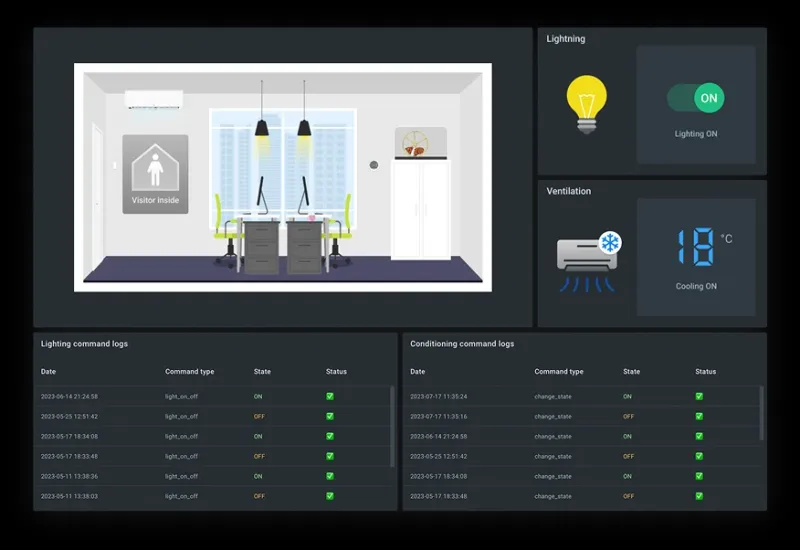
Photo: office IoT devices network monitoring dashboard energy management, via www.kaaiot.com
The Device You Didn't Configure Is the One Costing You Most
Walk through almost any mid-sized American office today and you will find dozens of networked devices that nobody formally provisioned. A smart thermostat installed by a facilities contractor. Occupancy sensors added during a post-pandemic space redesign. A fleet of networked printers that each maintains a persistent cloud connection. A handful of conference room displays running firmware that pings a manufacturer server every few minutes.
None of these devices were deployed with malicious intent. Most were added to solve a specific, immediate problem. But collectively, they form what energy and communications professionals are increasingly calling a shadow infrastructure — a layer of operational technology that consumes bandwidth, draws power, and generates data that no single team is responsible for monitoring.
The consequences are measurable, and they compound over time.
What Unmanaged Device Traffic Actually Does to Your Network
IoT devices are not passive endpoints. Even when they appear idle, the majority maintain active communication cycles — polling cloud APIs, syncing time servers, transmitting telemetry, or awaiting firmware updates. In isolation, each of these exchanges is trivial. Aggregated across dozens or hundreds of devices sharing the same network infrastructure, the picture changes significantly.
Network engineers who have conducted formal IoT audits in commercial office environments frequently report that unmanaged device traffic accounts for between 12 and 25 percent of total LAN utilization during off-peak hours. That traffic does not disappear during business hours — it competes with latency-sensitive applications: video conferencing platforms, VoIP systems, cloud-based ERP tools, and the real-time messaging infrastructure that modern teams depend on.
The result is not always a catastrophic outage. More often, it manifests as the kind of friction that is difficult to attribute: video calls that occasionally stutter, file transfers that take slightly longer than expected, application response times that hover just above acceptable thresholds. IT teams investigate, find no single cause, and move on. The IoT layer goes unexamined.
The Energy Dimension That Almost Nobody Is Tracking
Bandwidth consumption is only one side of the problem. The energy dimension is equally significant and considerably less understood.
Many IoT devices cycle between active and standby states in patterns that create unpredictable load on building electrical systems. Smart HVAC controllers, for example, may trigger compressor cycles based on sensor readings that have not been validated against actual occupancy data. Networked lighting systems operating on misconfigured schedules can maintain full illumination in unoccupied zones for hours. Printers and multifunction devices that lack proper sleep mode configuration draw between 10 and 30 watts continuously — a figure that seems negligible per unit but accumulates rapidly across a multi-floor office.
More problematically, these energy draws are rarely captured by existing monitoring infrastructure. Facilities management platforms track aggregate consumption at the circuit or floor level. IT asset management tools track device status but not power state. The result is a gap: energy is being consumed by devices that appear on no energy audit and generate alerts on no dashboard.
For businesses operating in states with mandatory energy disclosure requirements — California, New York, and Washington among them — this gap carries regulatory risk. For businesses pursuing sustainability certifications or ESG reporting commitments, it represents a material inaccuracy in reported figures.
Why the Silos Persist — and Why They Are Getting More Expensive
The fragmentation of responsibility between IT, facilities, and operations teams is not a new problem. But the proliferation of IoT devices has made that fragmentation significantly more costly. When communications infrastructure and energy systems were physically separate — servers in one room, HVAC in another — the lack of cross-functional visibility was manageable. Today, those systems are deeply interdependent.
A smart occupancy sensor that detects activity in a conference room may simultaneously trigger HVAC adjustment, update a room-booking platform, and generate network traffic. The energy event, the communications event, and the facilities event are aspects of the same action — but they are recorded, if they are recorded at all, in three separate systems that do not share data.
Organizations that continue to manage these systems in isolation will find that the cost of that approach increases as device counts grow. The average US commercial office added between 15 and 40 new networked devices per 1,000 square feet during the 2020–2024 period, driven by hybrid work retrofits and building automation upgrades. That trajectory is not reversing.
Building Unified Visibility: A Practical Framework
The solution is not to remove IoT devices — the operational value many of them provide is genuine. The solution is to bring them under the same visibility framework that governs the rest of your communications and energy infrastructure.
A practical starting point is a formal device discovery audit. Network scanning tools can identify every endpoint currently active on your infrastructure, including devices that were never formally registered in an asset management system. Cross-referencing that inventory against facilities records and energy metering data will typically surface a meaningful number of devices drawing power and consuming bandwidth that no team currently owns.
From there, the goal is instrumentation. Each device category should be assigned a responsible team, a baseline power consumption profile, and a traffic threshold. Deviations from those baselines — a printer generating unusual outbound traffic, a thermostat cycling more frequently than its schedule would suggest — become actionable alerts rather than invisible noise.
Several enterprise platforms now support this kind of unified IoT visibility, integrating network traffic analysis with smart metering data to provide a consolidated view of device behavior across both dimensions. For organizations that have not yet adopted such a platform, even a structured manual audit conducted quarterly will surface the majority of high-impact issues.
The Efficiency Case Is Straightforward
Businesses that have implemented unified IoT visibility programs consistently report improvements across both metrics that matter here. Network latency during peak hours decreases when device traffic is properly segmented and scheduled. Energy costs decline when devices are configured to match actual occupancy and usage patterns rather than factory defaults.
The investment required is modest relative to the ongoing cost of inaction. A single misconfigured HVAC controller driving unnecessary compressor cycles can add thousands of dollars annually to an energy bill. A cluster of unmanaged devices competing for bandwidth during peak hours can degrade the quality of communications infrastructure that cost considerably more to deploy.
The devices in your office are not going away. The question is whether your organization will manage them deliberately — or continue paying the price for not doing so.