What Nobody on Your Leadership Team Can Actually Answer: The True Energy Price of Staying Connected

Ask your Chief Communications Officer what the company spends on unified communications platforms each year. You will likely receive a precise figure within minutes. Ask that same executive what those platforms cost in terms of energy consumption — the servers, the endpoints, the always-on network hardware, the data center draw — and the conversation will stall. Not because the question is unreasonable, but because the answer has never been anyone's job to find.
This is the structural reality facing most mid-size and enterprise businesses in the United States today. Communications infrastructure has grown into one of the most energy-intensive categories in the modern enterprise, yet it remains almost entirely invisible to the professionals responsible for managing energy budgets. The result is a class of costs that nobody owns, nobody audits, and almost nobody can accurately estimate.
The Budget Line That Ends Too Early
In most organizations, the IT or communications budget captures licensing fees, hardware procurement, support contracts, and bandwidth costs. These are measurable, invoiced, and relatively easy to defend in a quarterly review. What those budget lines do not capture is the electrical demand that sustains all of it.
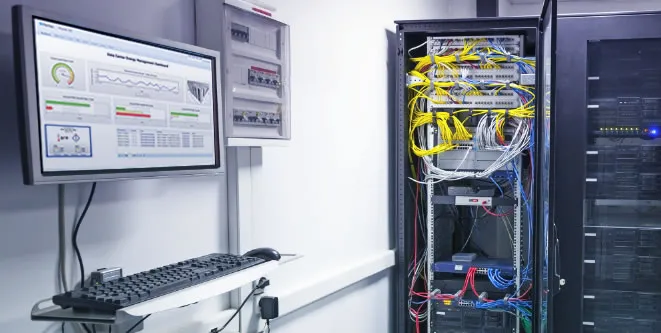
Consider the typical enterprise communications stack: a UCaaS platform, a video conferencing solution, a messaging layer, a contact center application, and some combination of SIP trunking or legacy telephony infrastructure. Each of these systems requires endpoints — desk phones, workstations, conference room hardware — and each of those endpoints draws power continuously, not just during active use. The servers and networking equipment that route all of this traffic add another layer of consumption that rarely appears in any communications-specific report.
Energy managers, meanwhile, are typically looking at facility-level utility bills. They can tell you how much electricity the building consumed last month. They cannot tell you how much of that figure is attributable to the communications stack versus HVAC, lighting, or manufacturing equipment. The granularity simply does not exist in most organizations.
The result is what might be called a phantom load philosophy: a shared, unspoken assumption that connectivity has no meaningful energy cost, or that if it does, someone else is responsible for tracking it.
Why the Silos Formed and Why They Persist
The separation between communications leadership and energy management is not accidental. It is a product of how enterprise functions evolved over the past two decades.
When enterprise communications meant desk phones and a PBX system, the energy footprint was modest and reasonably static. Energy managers could account for it as a fixed overhead line without much consequence. As communications infrastructure migrated to IP networks, then to cloud platforms, then to distributed hybrid environments, the energy profile became dramatically more complex — but the organizational structure never caught up.
Communications leaders are evaluated on uptime, call quality, message delivery rates, and user adoption. Energy managers are evaluated on utility costs, carbon reporting, and compliance with sustainability commitments. Neither set of performance metrics creates an incentive to look at the intersection. Both teams are, in a practical sense, rewarded for staying in their lane.
Adding to this inertia is the cloud migration narrative that has dominated enterprise technology planning for the better part of a decade. Many organizations moved workloads to the cloud with the implicit understanding that doing so would reduce their energy responsibilities. In a narrow sense, this is true — on-premises hardware was decommissioned, and the physical footprint shrank. But cloud services consume energy too, and that consumption is now embedded in a vendor's infrastructure rather than a company's own data center. It did not disappear; it became invisible.
What Gets Hidden in the Gap
When communications and energy management operate without a shared data framework, specific categories of cost reliably fall through the cracks.
Endpoint proliferation is among the most significant. Enterprises routinely deploy thousands of IP phones, conference room systems, and workstation peripherals that draw power around the clock. Device-level energy audits are rarely conducted, and decommissioned equipment often continues drawing power simply because no one has formally retired it from the network.
Redundancy infrastructure presents a similar problem. Backup communications systems — failover servers, secondary network paths, standby hardware — are designed to be always available, which means they are always consuming power. Because they are defined as contingency assets rather than operational ones, they frequently escape both the communications budget review and the energy audit.
Vendor-hosted services add another layer of opacity. When a company pays a monthly fee for a cloud communications platform, the energy cost of running that service is bundled into the vendor's operating expenses and passed along as part of the subscription price. There is no line item for kilowatt-hours. Organizations that have made sustainability commitments and need to report Scope 3 emissions — which include emissions from purchased services — often have no reliable method for estimating this figure.
How Forward-Thinking Organizations Are Responding
A small but growing cohort of US enterprises is beginning to treat this visibility gap as a solvable operational problem rather than an inherent limitation of how businesses are structured.
The most effective approaches share a common characteristic: they establish a shared data layer that both communications leaders and energy managers can access and interpret. This does not necessarily require a single platform that does everything. In many cases, it begins with something more modest — a cross-functional working group that meets quarterly to reconcile communications infrastructure changes with energy reporting, or a tagging taxonomy that allows IT asset management systems to feed data into energy dashboards.
Some organizations are going further, implementing network-level monitoring tools that can attribute power consumption to specific applications and infrastructure components. When a video conferencing system upgrade is proposed, the analysis now includes not just licensing cost and user experience improvements, but the projected change in energy demand across all associated endpoints and network hardware.
Vendor engagement is also evolving. Progressive procurement teams are beginning to include energy transparency requirements in RFPs for communications platforms, asking vendors to provide consumption estimates or carbon intensity data as part of the evaluation process. This is not yet standard practice, but it is gaining traction, particularly among companies with formal ESG reporting obligations.
The Organizational Change That Has to Come First
Technology and data frameworks matter, but the more fundamental requirement is organizational. Someone in the enterprise needs to own the intersection of communications infrastructure and energy consumption. Without explicit ownership, even the best visibility tools will produce reports that nobody acts on.
This does not necessarily mean creating a new role. In many organizations, it means expanding the mandate of an existing one — giving the energy manager a formal seat in communications infrastructure reviews, or requiring the communications director to sign off on energy impact assessments alongside cost and capability analyses.
The phantom load philosophy persists not because the data is impossible to collect, but because no one has been asked to collect it. Changing that requires deliberate structural decisions, not just better software.
For businesses that are serious about operational efficiency and sustainability reporting, the question is no longer whether to close this gap. The question is which team is going to own the work of closing it — and how soon that decision gets made.