Standby Is Not Free: The Compounding Energy Cost of Idle Communications Infrastructure
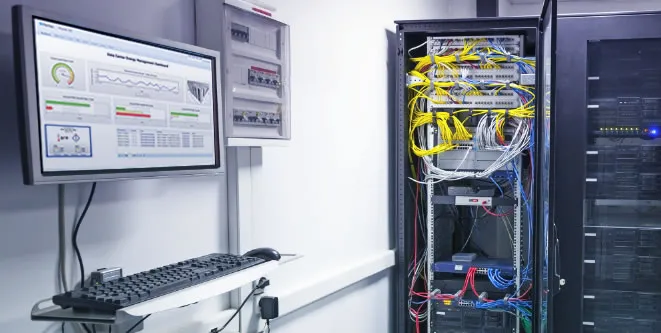
Photo: server room idle data center power consumption energy monitoring, via www.raritan.com
There is a persistent misconception in enterprise IT and facilities management that infrastructure not actively processing requests is infrastructure not consuming power. For communications servers—unified communications platforms, SIP gateways, voicemail systems, call recording appliances, and messaging brokers—this assumption is not only incorrect, it is quietly expensive.
Industry measurement data consistently places idle or standby power consumption for communications infrastructure between 20 and 40 percent of total data center energy expenditure in organizations that have not formally audited these systems. That range is not incidental. It reflects a category of energy spend that most businesses have never formally named, let alone assigned accountability for.
At NRGKomm, we refer to this as the phantom load problem—and it is one of the most straightforward efficiency gaps available to mid-market and enterprise organizations willing to look at their communications stack through an energy lens.
Why 'Idle' Is a Misleading Status
The word idle implies inactivity. In practice, a communications server that is not processing a call or delivering a message is still running a full operating system, maintaining network interfaces in a listening state, polling for configuration updates, sustaining session persistence for potential reconnects, logging telemetry, and in many cases running background compliance or encryption processes.
This is not a design flaw—it is an intentional architectural choice. Communications infrastructure is engineered for availability, not efficiency. The assumption baked into most enterprise communications platforms is that uptime is paramount and that power consumption is a secondary concern managed elsewhere, typically by the facilities or data center operations team rather than by the communications or IT group.
The result is a structural accountability gap. The team that configures and operates the communications stack is not responsible for the energy bill. The team that manages the energy bill does not have visibility into what the communications stack is actually doing at any given moment. Neither team has strong incentive to resolve the disconnect.
The Architectural Decisions That Perpetuate Phantom Loads
Several specific design patterns compound idle consumption in communications environments.
Over-provisioned capacity buffers. When communications systems are sized for peak load—a major all-hands event, a seasonal surge in contact center volume, a disaster recovery scenario—the infrastructure required to support that peak sits partially or fully idle for the majority of its operational life. A SIP trunk gateway provisioned to handle 500 concurrent sessions that rarely exceeds 80 sessions in normal operations is running at roughly 16 percent utilization while consuming power at a rate far closer to full capacity.
Legacy hardware running virtualized workloads. Many organizations have migrated communications applications to virtual machines while retaining the original physical hardware as a fallback or for ancillary functions. This creates scenarios where both the legacy appliance and the virtualized replacement are drawing power simultaneously, with the older hardware often being the less efficient of the two.
Always-on redundancy without tiered activation. High-availability configurations are standard practice in communications infrastructure, and for good reason. However, full active-active redundancy—where standby nodes consume power at nearly the same rate as primary nodes—is not the only way to achieve acceptable failover times. Many organizations have not evaluated whether tiered activation models, where secondary systems operate at reduced power states until needed, would satisfy their actual recovery time objectives.
Persistent logging and compliance recording infrastructure. Call recording, archival, and compliance systems are often configured to remain in a fully active state even during periods when the communications systems they monitor are generating minimal traffic. These platforms are typically sized for storage throughput and search performance rather than energy efficiency, and their idle consumption is rarely examined independently.
What an Idle Load Audit Actually Involves
Quantifying phantom loads in a communications environment requires a more granular approach than reviewing aggregate data center power consumption. The following framework provides a practical starting point.
Step one: Establish per-system baseline measurements. Using smart PDUs, inline power meters, or IPMI-based power reporting where available, capture the actual wattage drawn by each communications appliance or server during confirmed low-activity windows—typically between 2:00 and 5:00 a.m. on weekdays and throughout weekends. This establishes a defensible idle consumption baseline for each system.
Step two: Map utilization against provisioned capacity. Pull session, channel, and throughput data from your communications management platform for the same measurement periods. Calculate the ratio of actual utilization to provisioned capacity. Any system operating below 25 percent utilization during peak hours, and below 10 percent during off-peak hours, should be flagged for rightsizing review.
Step three: Identify consolidation and virtualization opportunities. For physical appliances running workloads that could be consolidated onto existing virtual infrastructure, calculate the power delta between the current configuration and the consolidated alternative. In many mid-market environments, this step alone identifies three to five systems eligible for retirement or consolidation within a single audit cycle.
Step four: Evaluate standby mode configurations. Review the power management settings on communications servers and appliances. Many enterprise platforms support ACPI power states or vendor-specific low-power modes that are not enabled by default. Enabling these modes on systems with predictable low-utilization windows can reduce idle consumption by 15 to 30 percent without any change to provisioned capacity.
Step five: Assign ongoing monitoring accountability. The most durable outcome of an idle load audit is not the immediate energy reduction—it is the establishment of a monitoring cadence that prevents phantom loads from re-accumulating. Assign specific ownership for communications infrastructure power consumption, integrate power metrics into your regular communications performance reviews, and set threshold alerts for anomalous idle consumption.
Translating Phantom Loads Into Recoverable Cost
The financial case for addressing idle communications loads is straightforward to construct once baseline measurements are in place. For a mid-sized enterprise operating a data center or colocation footprint in a US market with average commercial electricity rates near $0.12 per kilowatt-hour, a cluster of communications systems drawing 15 kilowatts during idle periods represents roughly $15,800 in annual energy spend before cooling overhead is factored in. Apply a standard power usage effectiveness multiplier of 1.4 for a typical enterprise data center environment, and that figure rises to approximately $22,100 per year—for infrastructure that is, by most operational definitions, doing nothing.
Multiply that across the full communications stack of a distributed enterprise with regional data centers, and the recoverable cost becomes significant enough to justify a dedicated audit engagement.
The Broader Efficiency Argument
Addressing idle communications loads is not merely a cost recovery exercise. It is an expression of operational maturity. Organizations that have visibility into how their infrastructure consumes energy at rest are better positioned to make informed decisions about capacity planning, vendor selection, hardware refresh cycles, and sustainability reporting.
As US regulatory and investor scrutiny of corporate energy consumption continues to intensify—particularly for companies navigating Scope 2 emissions disclosure requirements—the ability to demonstrate granular measurement and active management of communications infrastructure energy use will carry increasing weight.
Phantom loads are not a new problem. But in an environment where every efficiency gain is being examined for its contribution to both the bottom line and the sustainability ledger, they are a problem that no longer has a reasonable excuse for remaining unaddressed.