Disconnected by Design: Why Your Smart Building's IoT Devices Are Working Against Your Energy and Security Goals
The Building That Doesn't Know Itself
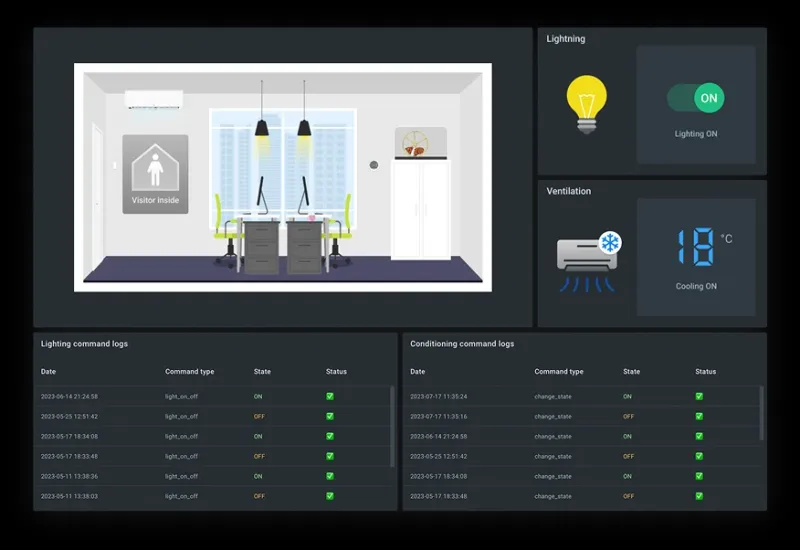
Walk through almost any commercial office building, manufacturing floor, or healthcare facility in the United States today, and you will find a paradox hiding in plain sight. The infrastructure is, by most measures, extraordinarily sophisticated — occupancy sensors embedded in ceiling tiles, HVAC controllers linked to thermostatic zones, smart lighting rigs that respond to daylight levels and motion. On paper, this is the smart building promise fulfilled.
In practice, however, most of these devices are operating in silos. They collect data. They act on local parameters. And they report to nobody in particular — or, at best, to proprietary dashboards that communicate nothing meaningful to the energy managers, IT administrators, or compliance officers who most need the information.
This is not a minor inefficiency. It is a structural problem that is quietly inflating energy expenditures and expanding the attack surface that your security team is responsible for defending.
The IoT Endpoint Explosion and Why It Outpaced Oversight
The commercial IoT market in the United States has grown with remarkable speed over the past decade. According to industry estimates, large commercial buildings now routinely operate hundreds to thousands of connected endpoints — and that number continues to climb as facility managers add new systems without retiring old ones.
The issue is not the volume of devices itself. The issue is the governance model — or rather, the absence of one. IoT deployments in smart buildings have historically been driven by individual departments or facility operations teams purchasing systems that solve a specific problem: a better HVAC controller here, a motion-activated lighting grid there. Each procurement decision makes local sense. The aggregate result, however, is a fragmented device ecosystem where no single platform holds a coherent picture of what is consuming energy, what is communicating with what, and what is operating outside of expected parameters.
For energy managers, this fragmentation means that real-time consumption data from HVAC systems, for example, never reaches the energy management software that could act on it. For IT and security teams, it means that dozens or hundreds of network-connected devices exist in a state of partial visibility — updated inconsistently, authenticated weakly, and monitored sporadically if at all.
The Energy Cost of Invisible Devices
Let us be specific about what unmanaged IoT infrastructure actually costs in energy terms.
Occupancy sensors that fail to communicate accurately with HVAC zone controllers will allow conditioning systems to run at full capacity in unoccupied spaces. Lighting systems that operate on static schedules rather than real-time occupancy data burn kilowatt-hours that serve no occupant. HVAC controllers that have drifted from their original calibration — a common occurrence in devices that receive no remote management — can overcool or overheat entire floors for months before anyone notices.
None of these failures are dramatic. They produce no alerts. They generate no incident reports. They simply consume energy in the background, consistently, day after day, adding up to what facilities analysts sometimes call "phantom load" — consumption that does not correspond to any productive operational output.
For a mid-sized commercial facility in a market like Chicago, Dallas, or Atlanta, this phantom load can represent a meaningful percentage of total energy expenditure. Scaled across a multi-site enterprise portfolio, the number becomes significant enough to warrant dedicated remediation investment.
The Security Dimension That Energy Discussions Too Often Ignore
The energy waste problem is serious. The security problem may be more urgent.
Unmanaged IoT devices in commercial buildings are, from a network security perspective, endpoints with credentials, network access, and firmware that may not have been updated since installation. Many building IoT devices run on lightweight operating systems that were never designed with enterprise security standards in mind. They use default credentials that facility staff rarely change. They communicate over protocols that prioritize reliability over encryption.
In a threat environment where adversaries actively scan for poorly secured connected devices, a smart building's HVAC controller or lighting management node is not an abstract risk. It is a documented attack vector. The 2013 Target data breach — still one of the most widely studied retail security incidents in US history — was initiated through a third-party HVAC vendor's network credentials. The lesson has been available for over a decade. Many enterprises have not yet acted on it.
When IoT devices operate outside of centralized communications infrastructure, security teams cannot enforce consistent patching, cannot monitor for anomalous traffic patterns, and cannot revoke access when a device is decommissioned or a vendor relationship ends. The device persists. The risk persists.
A Framework for Consolidation
Addressing both the energy and security dimensions of unmanaged building IoT requires a consolidation framework that treats device visibility as a prerequisite for everything else. The following structure offers a practical starting point for US enterprise facilities teams.
Step one: Complete device enumeration. Before any optimization is possible, organizations need a full inventory of every IoT endpoint operating on or adjacent to their networks. This includes devices procured through facilities management, devices installed by contractors, and legacy systems that may predate current IT governance policies. Network scanning tools combined with physical walkthroughs remain the most reliable method for producing an accurate count.
Step two: Classify by data type and communication protocol. Not all building IoT devices communicate the same way. Some use standard IP protocols and are straightforward to integrate. Others use proprietary protocols that require middleware or gateway hardware to bridge into centralized platforms. Understanding the communication landscape of your device population shapes every subsequent integration decision.
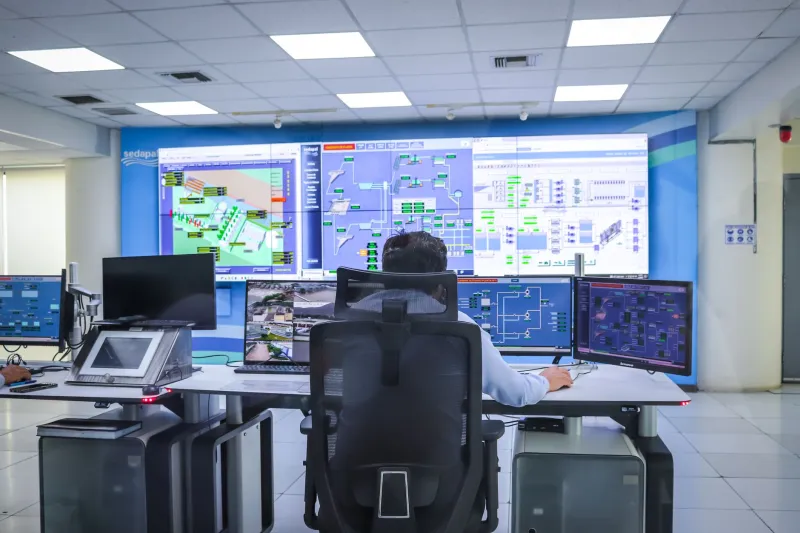
Step three: Establish a unified data layer. The goal is to route IoT data streams — occupancy, temperature, energy draw, motion, access events — into a single platform that energy managers and IT administrators can both interrogate. In practice, this often means deploying an IoT data aggregation layer that normalizes inputs from heterogeneous devices and feeds them into existing energy management and building automation systems.
Step four: Define baseline thresholds and automated alerts. Once data is flowing into a unified environment, organizations can establish what normal looks like for each device category. Deviations from baseline — an HVAC controller consuming 40 percent more energy than its zone average, a lighting node that has not reported occupancy data in 72 hours — become actionable signals rather than invisible anomalies.
Step five: Integrate with communications infrastructure. This is the step most facilities programs skip, and it is arguably the most valuable. When IoT data is connected to the communications layer — meaning that alerts route to the right people through the right channels in real time — the gap between detection and response narrows dramatically. An energy manager who receives an automated notification that a specific HVAC zone is overcooling an unoccupied floor can act within minutes rather than discovering the issue on the next monthly utility bill.
The Compounding Return on Visibility
There is a straightforward business case for investing in IoT consolidation infrastructure, and it operates on multiple timelines simultaneously. In the near term, closing the visibility gap reduces phantom energy load and lowers utility costs. In the medium term, it supports more accurate energy reporting — increasingly important as US regulatory frameworks around commercial building emissions continue to evolve in states like California, New York, and Washington. In the longer term, it hardens the security posture of facilities that are otherwise carrying unacknowledged network risk.
The smart building was sold as a system of systems — interconnected, intelligent, self-optimizing. For most commercial facilities today, that promise remains partially unfulfilled. The devices are present. The data exists. What is missing is the communications and management architecture to make it actionable.
Building that architecture is not a facilities project. It is a business strategy decision — and the organizations that treat it as such will find that the return extends well beyond the energy bill.